
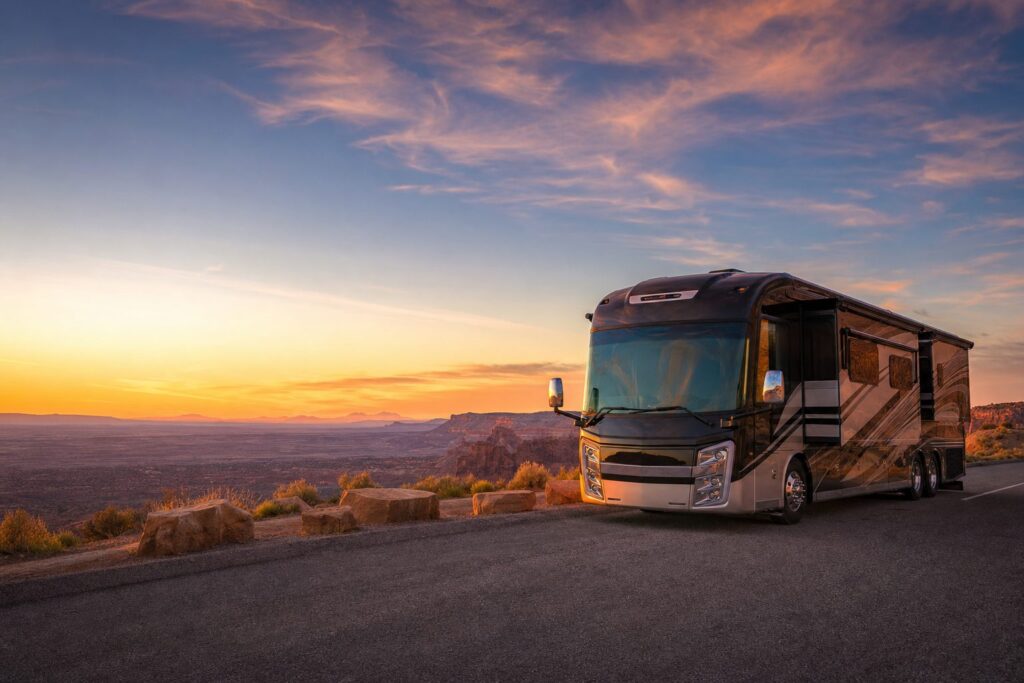
What License Do You Need to Drive an RV? CDL & Big-Rig Rules by State
By Calvin Whitlock · Last updated July 7, 2026 · How we built this
TL;DR: For the vast majority of RVers, the answer is simple: your regular car driver's license is all you need. No special license, and — this is the part people get wrong — no personal RV ever requires a commercial CDL, no matter how big it is, because a rig you drive for your own recreation isn't a commercial vehicle. The catch is a handful of states that require a non-commercial upgraded license (a Class A or Class B "housecar" or "exempt" license — still not a CDL) once your rig crosses certain lines. The three lines that matter: 26,000 lb GVWR (the big one — most states that require anything at all use this weight), 40-45 ft of length (California is the headline case — over 40 ft needs a non-commercial Class B), and towing a trailer over 10,000 lb (can push you to a non-commercial Class A). If you drive a van, a Class C, or a typical Class A under 26,000 lb, you're almost certainly fine on your normal license anywhere in the country. If you drive a 40-foot-plus Big-Rig Friendly diesel pusher or a heavy fifth wheel — the exact rigs most likely to cross those thresholds — this guide is for you. Confirm your own state at its DMV before you count on any of it.
I've been living and driving a big rig full-time for years, and I've gone through this myself. Here's the honest version: the internet is full of 50-state license tables, and half of them are out of date or copied from each other. So instead of handing you another table to trust, I'll teach you the three thresholds that decide the answer — then show you how to check your own state in about ten minutes.
How to read this: This is lived experience and current research, not legal advice — I'm a full-time RVer and the founder of this directory, not a lawyer or a DMV examiner. License rules are set state by state and they change without notice. Where I name a specific state's rule, it was web-verified in July 2026 and I say so; everywhere else I give you the threshold logic and tell you to confirm at the DMV in the state where your RV is registered. Don't publish-proof your travel plans off this page — call your DMV.
Do you need a special license to drive an RV?
In most states, for most rigs: no. A standard passenger driver's license — the one already in your wallet — covers a van, a travel trailer, a Class C, and a typical Class A motorhome. The label "special license" scares people, but for the average RV it simply doesn't apply.
Where it starts to apply is at the size where an RV stops behaving like a car and starts behaving like a truck. Only a minority of states require anything extra, and the ones that do almost always key it to weight — specifically a gross vehicle weight rating (GVWR) of 26,000 lb — and, in a couple of cases, to length. Below those lines, your regular license is enough coast to coast.
So the honest one-sentence answer: you probably don't need a special license, but "probably" depends on how heavy and how long your rig is, and on which state issued your license. If your rig is under 26,000 lb GVWR and under 40 feet, stop worrying — you're covered. If it's over either line, keep reading, because that's exactly where a few states ask for more.
Do you need a CDL to drive an RV?
No. Not for a personal RV — ever. This is the single most common piece of misinformation in RVing, so let me be blunt about it: a commercial driver's license (CDL) is for commercial vehicles — vehicles operated in commerce, for hire, hauling freight or paying passengers. An RV you drive for your own vacations and your own life is, by definition, not a commercial vehicle. Federal motor-carrier rules don't treat it as one.
Under federal guidance, a vehicle used strictly for non-business purposes does not require a CDL — the federal commercial rules simply don't reach it. What federal law does do is leave ordinary driver-licensing to the states. So a state can decide that a very heavy or very long personal RV needs a higher class of non-commercial license — but that's a non-commercial credential (often called "Class A/B non-commercial," "exempt," or "housecar"), not a CDL. You take a knowledge test and usually a road test in your own rig; you don't get pulled into the commercial world of medical cards, logbooks, and DOT numbers.
You'll see a couple of listicles claim a few states "require a CDL" for the biggest personal rigs. Treat that as sloppy shorthand for "a CDL-class weight rating" — the practical, honest reality is that the credential a personal RVer might need, in the small number of states that require anything, is a non-commercial upgrade. If a DMV ever tells you otherwise for a rig you use purely for recreation, ask them to show you the statute — and confirm it, because it's the exception, not the rule.
What kind of license do you actually need? The three thresholds
Forget the 50-state table for a minute. Three thresholds decide almost every RV license question. Learn these and you can figure out your own situation faster than you can find a current table online.
1. The 26,000 lb GVWR line (the big one). This is the weight most states use as the trigger. Under 26,000 lb GVWR, your regular license is enough in every state. At 26,001 lb and up, a minority of states require a non-commercial Class B (for a single heavy vehicle like a big diesel pusher). GVWR is the rated max loaded weight on your rig's placard — not what it weighs empty — so check the sticker, usually in a door jamb or a storage bay.
2. The length line (40-45 ft). A few states add a length rule on top of weight. California is the headline case: a motorhome over 40 feet (up to the 45-ft max California allows) requires a non-commercial Class B "housecar" license, verified against the California Vehicle Code in July 2026 — and California also restricts 40-ft-plus motorhomes to certain highways and within about a mile of them. If you run a 43-45 ft coach, length is the threshold most likely to catch you.
3. The tow line (10,000 lb trailer). How heavy the thing behind you is can bump you up a class. When the towed trailer or fifth wheel exceeds 10,000 lb GVWR and the combination is over 26,000 lb, some states move you from a non-commercial Class B to a non-commercial Class A. Texas is a clean, web-verified example: a single vehicle at 26,001+ lb towing 10,000 lb or less needs a non-commercial Class B; if the towed unit is over 10,000 lb, it's a non-commercial Class A (still exempt — still not a CDL).
Run your own numbers against these three lines and you'll know immediately whether you're in "regular license, relax" territory or "call the DMV" territory.
Can you drive a motorhome with a regular car license?
Almost always, yes. If your motorhome's GVWR is under 26,000 lb — which covers essentially every Class B camper van, every Class C, and a large share of Class A gas coaches — your standard car license is all you need in all 50 states. You don't need a special endorsement, a road test, or anything beyond what you already carry.
The "yes" turns into "check first" only when the rig gets genuinely big: a heavy Class A diesel pusher over 26,000 lb GVWR, or a coach over 40 feet in a length-rule state like California. Those are the rigs where a small number of states ask for a non-commercial upgrade. Everything smaller drives on your normal license.
Here's the practical read for a shopper: if you're buying a van, a Class C, or a mid-size gas Class A, license class should not factor into your decision at all — you're covered. If you're stepping up into a 40-foot-plus coach or a big fifth-wheel setup, add "what license does my state require for this GVWR and length?" to your buying checklist before you sign, not after you're parked in the driveway wondering.
Which states require a non-commercial special license for big rigs?
A minority do — and the honest answer is that the exact list shifts, so I'm not going to hand you a stale 50-state table and pretend it's gospel. What's stable is the logic: the states that require anything almost always trigger it at 26,000 lb GVWR, sometimes with a length rule (California's 40-ft housecar line) or a tow-weight rule (the 10,000 lb trailer bump to Class A) layered on top.
States commonly cited as requiring a non-commercial Class A or Class B for heavy or long personal rigs include California, Texas, Nevada, New Mexico, North Carolina, Pennsylvania, Maryland, Kansas, and Wyoming — but sources disagree at the edges, and a state can revise its rule between the time a blog is written and the time you read it. So treat that as a "look here first" list, not a verdict. The two I verified to specific figures in July 2026 are California (non-commercial Class B for a housecar over 40 ft; non-commercial Class A when towing a travel trailer at or above 10,000 lb GVWR / a fifth wheel at or above 15,000 lb) and Texas (non-commercial Class B at 26,001+ lb towing ≤10,000 lb; non-commercial Class A when the towed unit exceeds 10,000 lb).
The one thing I'll say flatly: in none of these is it a commercial CDL for a personal RV. It's a non-commercial upgrade you can get at a regular DMV. If your rig crosses a threshold, the next section is how to nail down your own state's exact rule in a few minutes.
Do you need a CDL to drive a Class A motorhome?
No — a Class A motorhome, driven for personal use, never requires a commercial CDL, regardless of size. This deserves its own answer because "Class A" sounds official and heavy, and people assume the biggest motorhome class must need the biggest license. It doesn't work that way. A Class A is still a recreational vehicle, and a personal RV is never a commercial vehicle.
What a big Class A can trigger — a 40-foot-plus diesel pusher is exactly the rig most likely to — is a non-commercial upgrade in the handful of states that require one: a non-commercial Class B once you're over 26,000 lb GVWR, a California housecar license once you're over 40 feet, or a non-commercial Class A if you're towing a heavy (10,000 lb-plus) trailer behind it. All non-commercial. All obtainable at a normal DMV with a knowledge test and usually a road test in your own coach.
For big-rig owners this is the whole ballgame: your rig's size doesn't push you toward a CDL — it pushes you toward possibly needing a non-commercial state upgrade. Know your GVWR (the placard), know your length, know your loaded tow weight, and check your state. That's the entire homework assignment.
How do you check your own state's RV license rules?
Ten minutes at your own state's DMV site beats any table on the internet, including this one. Because these rules change and vary, the reliable move is to verify against the source that actually governs you: the DMV in the state where your RV is registered and your license is issued. Here's the checklist I'd run:
- Get your three numbers. Your rig's GVWR (the placard in a door jamb or bay — the rated max, not empty weight), your overall length in feet, and, if you tow, your trailer's GVWR. You can't ask the right question without these.
- Search your state DMV for "non-commercial Class A / Class B" or "housecar / RV license." Look specifically for the weight and length thresholds. Most states publish a license-class chart.
- Compare against the three thresholds: over 26,000 lb GVWR? over 40 ft (in a length-rule state)? towing over 10,000 lb? If you clear all three by a comfortable margin, you're on your regular license.
- If you're close to a line, call the DMV and ask directly — give them your exact GVWR, length, and tow weight and ask what class of non-commercial license applies. Write down who told you.
- Re-check when you buy a bigger rig or move states. The rule follows the state that licenses you, and it can change when either does.
That's the honest system: not "trust the table," but "know your numbers and confirm at the source." It's the same discipline as weighing your loaded rig at a CAT scale instead of guessing — the real numbers are the ones that keep you legal and safe.
How we built this
This guide answers the RV license questions people actually search for and frames each one honestly: what's federal (personal RVs are not commercial vehicles, so no personal RV needs a commercial CDL), what's set by your state (whether a big or long rig needs a non-commercial Class A/B upgrade), and where the real dividing lines fall (26,000 lb GVWR, 40-45 ft length, 10,000 lb tow).
I write from years of full-time big-rig RVing — owning, driving, and licensing a 40-foot-plus rig — so the big-rig angle here is first-hand, not theory. But I'm an RVer and the founder of this directory, not a lawyer or a DMV examiner: where a rule varies by state or could change, I've said so and pointed you to the DMV rather than inventing a tidy universal answer. Research and drafting for this page were AI-assisted and reviewed by a human (me) before publishing. No business paid for placement, and nothing here was written to sell you a product.
I deliberately did not publish a definitive 50-state license table. Those tables go stale the moment a state amends a threshold, and a wrong cell here could put someone on the road with the wrong license. The threshold framework plus "confirm your state at the DMV" is the more honest and more durable tool.
Sources
- Federal Motor Carrier Safety Administration (FMCSA) — guidance that recreational/non-business vehicle use is outside the federal commercial-CDL requirement, and that ordinary licensing is left to the states.
- California DMV / California Vehicle Code + Caltrans — non-commercial Class B "housecar" license for motorhomes over 40 ft (up to 45 ft) and the CVC restriction of 40-ft-plus motorhomes to certain highways.
- Texas Department of Public Safety — non-commercial Class A/B "exempt" license thresholds (26,001+ lb GVWR; the 10,000 lb tow line).
- State-by-state RV license references (Escapees RV Club, Outdoorsy, Changing Gears, RV industry guides) — used to identify which states are commonly cited as requiring a non-commercial upgrade; specifics were treated as "confirm at DMV," not asserted as fixed fact.
Verification status (last verified July 2026): The federal "personal RVs are not commercial vehicles / no commercial CDL" point, the 26,000 lb GVWR threshold, and the California (over-40-ft housecar) and Texas (26,001 lb / 10,000 lb tow) specifics were web-verified to the figures cited. Other named states are given as "commonly cited — confirm at your DMV" because their exact thresholds vary and change without notice. No state threshold on this page is asserted as universal fact; no license figure here is fabricated.
Frequently asked questions
Do you need a special license to drive an RV?
For most rigs, no — a standard passenger driver's license covers a van, travel trailer, Class C, and a typical Class A under 26,000 lb GVWR in every state. A minority of states require a non-commercial upgraded license only when a rig crosses certain lines, chiefly a GVWR of 26,000 lb (some also add a 40-45 ft length rule, like California). If your rig is under 26,000 lb and under 40 ft, you're covered coast to coast; if it's over either line, confirm your state's rule at the DMV.
Do you need a CDL to drive an RV?
No — a personal RV never requires a commercial CDL, regardless of size, because a vehicle you drive for your own recreation isn't a commercial vehicle. Federal rules leave ordinary licensing to the states, and the most any state requires for a big personal rig is a non-commercial upgraded license (Class A or B), not a CDL. You take a knowledge test and usually a road test in your own rig — no commercial medical card, logbook, or DOT number involved.
What kind of license do you need to drive an RV?
It comes down to three thresholds: 26,000 lb GVWR (the main one — over it, some states require a non-commercial Class B), length (California requires a non-commercial Class B "housecar" license over 40 ft), and tow weight (a trailer over 10,000 lb can bump you to a non-commercial Class A in some states). Under all three lines, your regular car license is enough anywhere. Over any of them, check the DMV in the state that issued your license.
Can I drive a motorhome with a car license?
Almost always, yes. If the motorhome's GVWR is under 26,000 lb — which covers nearly every Class B van, every Class C, and many gas Class A coaches — your standard car license works in all 50 states. The only rigs that may need more are heavy Class A diesel pushers over 26,000 lb GVWR, or coaches over 40 feet in a length-rule state like California, where a small number of states require a non-commercial (not commercial) upgrade.
Do you need a CDL to drive a Class A motorhome?
No. A Class A motorhome driven for personal use never requires a commercial CDL, no matter how big it is — it's still a recreational vehicle. A large Class A can trigger a non-commercial upgrade in the few states that require one: a non-commercial Class B over 26,000 lb GVWR, a California housecar license over 40 ft, or a non-commercial Class A if you're towing a trailer over 10,000 lb. All obtainable at a regular DMV.
Do you need a special license to drive a motorhome?
Only if the motorhome is large enough to cross a state threshold — otherwise your regular license is fine. The lines to watch are 26,000 lb GVWR and, in states like California, 40 ft of length. A minority of states require a non-commercial Class A or B upgrade above those lines; none require a commercial CDL for a personal motorhome. Get your rig's GVWR and length off the placard, then confirm the rule with the DMV in your licensing state.
Compare across the directory: What "Big-Rig Friendly" means (the standard behind every score, and where GVWR and length come from) · RV Classes Explained (Class A, B, and C — which class you're actually driving) · RV Weight Explained (GVWR, GCWR, and how to read your placard — the numbers this whole guide turns on) · Maximum RV Length by State (the length limits that pair with California's 40-ft license rule). License class is a weight-and-length question, so the weight and length pages are the ones to read next.
[ Submit a correction → ] Know your state's exact RV license threshold, or spot a rule that's changed since July 2026? Tell me the state and the statute and I'll verify and update the guide.