
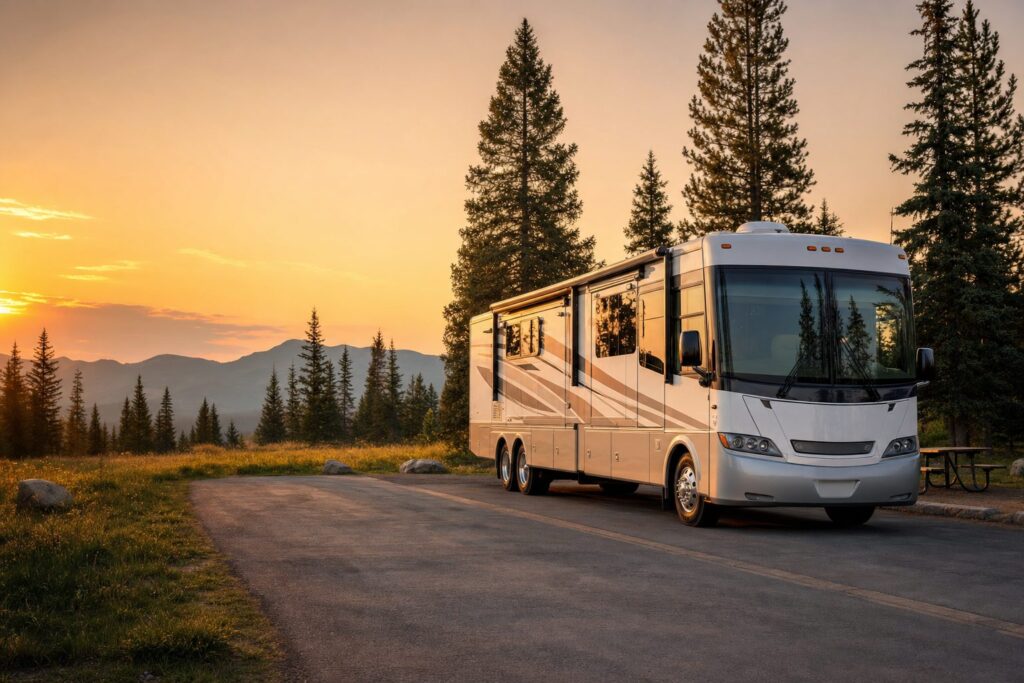
What Is Boondocking? A Big-Rig Guide to Dry & Dispersed Camping
By Calvin Whitlock · Last updated July 7, 2026 · How we built this
TL;DR: Boondocking is camping in your RV with no hookups — no shore power, no water spigot, no sewer connection — usually on free public land like BLM or National Forest, running entirely off your own batteries, water tank, and holding tanks. You'll also hear it called dry camping (same idea — no hookups, anywhere, even a paved lot) and dispersed camping (the land-agency term for camping outside a developed campground). Boondocking is the version of dispersed camping that a vehicle can actually drive to. For a 40-foot-plus Big-Rig Friendly rig, the definition is the easy part — the hard part is that half the pretty spots you'll see online sit at the end of a rutted two-track a 45-footer can't reach, or in a clearing with nowhere to turn a 60-foot rig-plus-toad around. This guide covers what boondocking is, how it's legal (mostly, within stay limits), how to go without hookups, and how to find sites a big rig can get into and back out of.
I've been living and driving a big rig full-time for years, a good chunk of it off-grid out West. I'll give you the honest version — including the part where the rig is too big for the spot and you have to back out a quarter mile. That happens.
How to read this: I'm an RVer, not a lawyer or a ranger. Where I mention a stay limit or a public-land rule, treat it as the general pattern — the real numbers vary by BLM field office and by National Forest, and they change. Confirm the specific rule for the specific spot before you count on it. This is lived experience, not legal advice.
What is boondocking?
Boondocking is overnighting in a self-contained RV with zero hookups — no electric, no water, no sewer — most often for free on public land such as BLM (Bureau of Land Management) or National Forest ground. "Self-contained" is the whole game: you're living off your freshwater tank, your gray and black holding tanks, and a battery bank (usually helped along by solar). When those run out, your stay is over — nothing at the site is going to refill or recharge them.
The word itself comes from "the boondocks" — out in the sticks, away from everything. That's the spirit of it: you're parked somewhere undeveloped, no neighbors thirty feet away, no reservation, no hookup pedestal. For a lot of us that's the entire appeal. It's quiet, it's free or nearly free, and the view out the windshield beats any RV resort.
It's also the most self-reliant way to camp. There's no office to call when something's wrong, no 50-amp pedestal to save you if your batteries die, and often no cell signal to look up the answer. You bring what you need or you go without. In a big rig that cuts both ways — you've got more tank capacity and more roof for solar than a van does, but you're also trying to park a bus in places that were never laid out for one.
What does boondocking mean vs. dry camping and dispersed camping?
These three terms overlap so much that most RVers use them interchangeably — but there's a useful distinction underneath. Here's the plain version:
- Dry camping describes the how: camping with no hookups, full stop. You can dry camp anywhere — a Walmart lot, a rally field, a friend's driveway, or a developed campground site that just has no utilities. Dry camping says nothing about where; it only says you're not plugged in.
- Dispersed camping is the land-agency term for camping outside a designated, developed campground on public land — no marked sites, no facilities, no fee. It's the official word you'll see on BLM and Forest Service pages. A "dispersed campground" isn't really a campground at all; it's an area where dispersed camping is allowed.
- Boondocking is the RVer's word for dry camping out on undeveloped land — essentially, dispersed camping that a rig can drive to. The commonly drawn line: boondocking spots are reached by roads in decent enough shape and have room to park and turn a vehicle around, whereas "dispersed camping" in the strict sense can include walk-in tent spots no RV will ever see.
So: all boondocking is dry camping, most boondocking happens on dispersed public land, but not all dry camping is boondocking (a Cracker Barrel lot is dry camping, not boondocking). Don't lose sleep over the vocabulary — but knowing that "dispersed" is the word the agencies use will help you search their maps.
One more distinction that matters for a big rig: boondocking is not the same as grabbing a single overnight in a parking lot or rest area. Those are dry-camp stopovers — a legal place to sleep for one night on the way to somewhere, with their own store-by-store and state-by-state rules. If that's what you're actually after, we scored the realistic non-campground options — truck stops, rest areas, casinos, Cracker Barrel, Walmart — for big rigs on a separate page: Where Can You Park an RV Overnight? This guide is about the other thing — parking out on the land for a stretch, off-grid.
Is boondocking legal? (Is boondocking illegal?)
Boondocking is generally legal — it's dispersed camping on public land, and the BLM and Forest Service both allow it across much of the West — but it's legal within limits, and the limits vary by office and forest. It is not a free-for-all, and treating it like one is how areas get closed.
Here's the honest framework, web-verified for July 2026 and framed the way it actually works:
- Stay limits. On BLM land, dispersed camping is commonly limited to 14 days within a 28-day period, after which you're expected to move on — often a set distance away (25 miles is a figure BLM offices commonly use) before the clock resets. But some high-use areas near popular towns cut that to 7 days or even less. National Forests usually run a 14-day limit too, then require you to leave the area for a stretch before returning. These are the typical numbers — your specific field office or forest may differ, so check.
- Where you can drive. This is the one that bites big rigs. Many forests only allow you to pull off the road for dispersed camping within a short distance of a designated route — I've seen it set at 150 feet in some regions, 300 in others, and 30 in others, spelled out on that forest's Motor Vehicle Use Map (MVUM). A growing number of BLM districts have gone "designated routes / designated sites only," meaning you can't just drive out across the desert to find a spot anymore — you stay on established tracks. Don't assume the old "drive anywhere and pick a flat spot" rule still applies; in 2026 it often doesn't.
- Fees and permits. A short dispersed stay is usually free and permit-free, though some regions (like the Southwest's Long-Term Visitor Areas) run a paid seasonal permit system.
So, "is boondocking illegal?" No — not the practice itself. What's illegal is boondocking where it isn't allowed (private land you don't have permission for, closed areas, city limits, most developed recreation areas) or past the posted limits. The related RV rules — like the store-by-store reality of overnight parking — follow the same pattern: it's rarely a clean nationwide "yes" or "no," it's local. Confirm the rule for your exact spot on the agency's site or with a quick call to the field office. Ranger stations answer this stuff all day.
Can a big rig actually boondock?
Yes — but the constraint is never "is there room for the rig to sit," it's "can a 40-to-60-foot rig get down the access road, and can it turn around at the end." A van boondocks almost anywhere. A 45-foot diesel pusher pulling a toad boondocks anywhere it can reach and reverse out of — which is a much shorter list, and the single most important thing to understand about doing this in a big rig.
Four things decide whether a spot is big-rig boondockable, and none of them are the campsite itself:
- Road width and surface. A lot of forest and BLM roads were cut for logging trucks or ranch use — which sounds encouraging until you hit deep ruts, soft sand, washboard, or a mud section after rain. A long wheelbase drags its belly on ruts a truck clears easily, and a heavy rig sinks where a Jeep floats. Gravel and hardpack: usually fine. Soft, boggy, or steeply crowned: that's how rigs get stuck miles from a tow.
- Turnaround. This is the one that ends trips. If you can't clearly see room to turn a 60-foot rig-plus-toad around at the site, do not commit to the road — because the alternative is backing the whole thing out, sometimes a quarter mile, sometimes with a spotter walking behind you. If you can't see the turnaround, the answer is no.
- Getting back out. A road you rolled in on downhill can be a different animal loaded and heading out uphill, especially on loose surface or after weather. Always be honest about whether you can climb back out, not just coast in.
- Overhead and approach angle. Tree limbs over the two-track threaten a 13'6"-ish roofline, and a long rear overhang drags on the lip where a road dips into a wash. Low branches and steep approach breaks catch big rigs where nothing else notices.
How I actually do it: scout on satellite before I ever turn the wheel. Follow the access road on the map from the pavement all the way to the spot, looking for width, gentle curves, and a visible clearing to turn in. Read the community notes on the camping apps — real RVers flag "not for big rigs" and "no turnaround past the cattle guard," and those notes are gold. When in doubt, I'll unhitch the toad and drive the road first, or just pick the bigger, more open site and skip the dramatic one. Out West in open country, big-rig boondocking is genuinely easy — wide gravel, huge flat pads, room everywhere. In tight, treed, mountain country it gets real careful, real fast. Restraint is a skill here: some spots just aren't worth it, no matter how good the photo looks.
How do you find boondocking sites (a big rig can reach)?
You find sites by layering two kinds of maps: one that shows you where camping is legal (the public-land boundaries), and one that shows you whether a big rig can get there (community field notes). Either one alone will get you in trouble. Here's the stack that works:
- Land-boundary tools tell you what you're allowed to camp on. The BLM's public GeoBrowser and the U.S. Forest Service site show surface-management boundaries and, in many districts, travel/route data. Apps like onX Offroad and Gaia GPS overlay public-vs-private land with offline maps — worth their weight when you lose signal, which you will. onX also carries road-difficulty ratings, which matter more to us than to anyone else.
- Community-report apps tell you whether the spot is actually reachable and worth it. Campendium, iOverlander, and FreeRoam are crowd-sourced: real campers leave notes on road condition, shade, cell signal, and — critically — whether a big rig fit and could turn around. iOverlander's web version is free with no account; FreeRoam layers in cell-coverage and land maps; Campendium's reviews are where the "we brought our 40-footer and…" gold lives.
The workflow: pick a general region on a land-boundary layer to confirm it's legal public land, zoom in on onX or Gaia to verify the boundary and eyeball the access road, then cross-check Campendium or FreeRoam for field notes on whether rigs your size have made it in. Filter or read for length. Then — always — confirm on satellite view that you can see a turnaround before you drive it. Maps get you 90% of the way; your own eyes on the satellite image close the gap.
If you'd rather ease into it, two paid memberships park you on private land instead of raw public land, and both are worth knowing:
- Harvest Hosts — an annual membership that gets you free overnight stays at farms, wineries, breweries, and attractions. No hookups (your rig must be self-contained), generally one night, and you're expected to buy something — a bottle, some produce, a meal. Many hosts have room for big rigs, but you filter and call ahead, because a tight winery lot is no place to discover your turning radius.
- Boondockers Welcome (now bundled with Harvest Hosts) — a network of private residences offering stays of roughly one to five days. Unlike raw boondocking, a majority of these hosts actually offer some form of hookup, and listings note rig-size limits, so it's a softer landing than a forest road.
Pricing on both changes — check current rates — but the model is the same: you're dry camping on someone's property with permission, which sidesteps the stay-limit and road-access headaches of public land entirely.
How long will an RV battery last boondocking?
Honest answer: it depends entirely on your battery bank, your chemistry, your draw, and your solar — anyone who gives you a flat number is guessing. What I can give you is the levers that decide it, because those are real and they're what you actually control.
- Battery bank size and chemistry. More amp-hours = more runtime, obviously. But chemistry matters as much as size: traditional lead-acid/AGM batteries you should only draw down to about 50% before you're damaging them, so half your rated capacity is really "off limits." Lithium (LiFePO4) you can safely run much deeper — closer to empty — so a lithium bank of the same nameplate size gives you meaningfully more usable power. This is why big-rig full-timers who boondock a lot tend to end up on lithium.
- Your draw. The battery isn't the enemy — the residential fridge, the inverter, and anything that makes heat are. A furnace fan cycling all night, a big inverter running a coffee maker, phones and laptops charging: it adds up. The furnace fan in particular surprises people, because the furnace runs on propane but the blower runs on your battery.
- Solar and recharge. A roof of solar changes the whole equation — instead of asking "how long until the battery dies," you're asking "does the sun put back what I take out each day." A big rig has a huge roof, which is an advantage most van boondockers would kill for. Cloudy stretches and short winter days are where solar falls behind and a generator earns its keep.
- Water and tanks, not just amps. Batteries usually aren't even the first thing to run out — freshwater and holding-tank capacity often cap the stay first. You go home when the fresh tank's empty or the black tank's full, whichever comes first, and managing water (Navy showers, paper plates, catching gray water) stretches a boondocking stay more than any battery upgrade.
The real move is to know your own numbers. Watch your battery monitor for a couple of off-grid nights and you'll learn your rig's honest runtime far better than any blog's average — including this one's.
Is boondocking safe?
For most people, in most places, yes — boondocking is about as safe as camping gets, and the thing that actually hurts people isn't other people, it's the environment and the isolation. The nightmare scenario RVers picture — someone bothering you out in the middle of nowhere — is rare, precisely because you're in the middle of nowhere. Nobody's out there.
The real risks are duller and more likely: getting stuck or breaking down miles from help with no cell signal, running out of water or power, weather turning an access road to mud, or a medical issue far from a hospital. Those are the ones that plan around. Tell someone your rough location and when you'll check in. Keep enough fuel, water, and battery margin that a plan B doesn't strand you. Know that you can climb back out the road you came in on. For a big rig especially, the "safe" call is often the boring one — the wide-open, easy-access spot over the remote, tight, dramatic one. And trust your gut: if a spot or a situation feels off when you pull in, leave. There's always another clearing.
How we built this
This guide defines boondocking and the terms tangled up with it — dry camping (no hookups, anywhere) and dispersed camping (the land-agency term for camping outside a developed campground) — the way the RV community and the land agencies actually use them, then reads the whole thing through a big-rig lens because almost nobody else does.
I write from years of full-time big-rig RVing, including long off-grid stretches out West — so the road-access, turnaround, and "back the rig out a quarter mile" parts are first-hand, not theory. I'm an RVer and the founder of this directory, not a lawyer or a ranger: every legal or policy point here (BLM and National Forest stay limits, distance-from-road rules, permits) is framed as the general pattern that varies by office and forest and changes — because it does — rather than stated as a single universal fact. Research and drafting for this page were AI-assisted and reviewed by a human (me) before publishing. Harvest Hosts and Boondockers Welcome are described from their own published terms; no pricing is asserted as fixed. No business paid for placement, and nothing here was written to sell you a product.
Sources (last verified July 2026):
- Bureau of Land Management — Camping on Public Lands (dispersed-camping rules, stay limits, LTVA)
- U.S. Forest Service — regional Dispersed Camping guidance (Intermountain Region, Pacific Southwest Region) on 14-day limits and Motor Vehicle Use Map distance-from-road rules
- Harvest Hosts / Boondockers Welcome — how the memberships work (self-contained requirement, no hookups, stay terms)
- Boondockers Welcome — boondocking / dry camping / dispersed definitions
Verification status (last verified July 7, 2026): Stay limits (14 days / 28-day window; the 25-mile move figure) and distance-from-road rules (150/300/30 ft, MVUM-dependent) are described as the common patterns BLM and the Forest Service publish, explicitly framed as varying by field office and forest — no single number is asserted as universal. The boondocking/dry/dispersed distinction reflects how the agencies and community use the terms. Battery, solar, and water points are given as levers and safe-discharge ranges (lead-acid ~50%, lithium deeper), not fabricated amp-hour or "lasts X days" figures. Membership details reflect Harvest Hosts / Boondockers Welcome published terms; pricing is left to confirm because it changes.
Frequently asked questions
What is boondocking?
Boondocking is camping in a self-contained RV with no hookups — no electric, water, or sewer — most often for free on public land like BLM or National Forest. You run entirely off your own battery bank, freshwater tank, and holding tanks, usually with solar to stretch the stay. It's also called dry camping (no hookups anywhere) and is a form of dispersed camping (camping outside a developed campground). For a big rig the definition is easy; reaching and turning around at the site is the hard part.
What does boondocking mean vs. dry camping and dispersed camping?
Dry camping means camping with no hookups, anywhere — even a parking lot or a campground site without utilities. Dispersed camping is the land-agency term for camping outside a developed campground on public land. Boondocking is the RVer's word for dry camping out on undeveloped land — essentially dispersed camping a vehicle can drive to. All boondocking is dry camping; most boondocking is dispersed camping on public land; but a Walmart-lot overnight is dry camping, not boondocking.
Is boondocking legal?
Generally yes — dispersed camping on BLM and National Forest land is allowed across much of the West, but within limits that vary by office and forest. Stay limits are commonly around 14 days in a 28-day period before you must move on, and many areas now restrict how far off a designated route you can drive (often spelled out on a forest's Motor Vehicle Use Map). Boondocking is only illegal where it isn't allowed — private land, closed areas, city limits — or past the posted limits. Confirm the rule for your exact spot with the field office.
How long will an RV battery last boondocking?
It depends on your bank size, chemistry, draw, and solar — there's no honest flat number. Lead-acid and AGM batteries should only be drawn to about 50% before damage, while lithium can safely run much deeper, so lithium of the same size gives far more usable power. Your furnace blower, inverter, and residential fridge are the big drains. Solar can put back what you use each day, and a big rig's large roof is an advantage. Often it's your freshwater or holding tanks, not the battery, that ends the stay first.
How do you find boondocking sites?
Layer two kinds of maps. Land-boundary tools — the BLM GeoBrowser, the Forest Service site, and apps like onX Offroad and Gaia GPS — show where camping is legal and let you download offline maps. Community-report apps — Campendium, iOverlander, and FreeRoam — carry real campers' notes on road condition, cell signal, and whether a big rig fit and could turn around. Confirm legal land first, read the field notes for rig size, then check satellite view for a visible turnaround before you commit to the road.
Is boondocking safe?
For most people in most places, yes — it's about as safe as camping gets, and the real risks aren't other people but the environment and isolation: getting stuck or breaking down miles from help with no signal, running low on water or power, or weather turning the access road to mud. Plan around those: tell someone your location, keep fuel/water/battery margin, make sure you can get back out, and trust your gut — if a spot feels off, leave. For a big rig, the safe call is usually the wide-open, easy-access spot over the tight, dramatic one.
Compare across the directory: What "Big-Rig Friendly" means (the standard behind every score) · Where Can You Park an RV Overnight? (the one-night, non-campground options — the flip side of boondocking) · RV Rules Explained (the 3-3-3, 10-year, and overnight-parking conventions in plain English). Boondocking is where you go off-grid on the land; the overnight page is where you sleep legally for a single night on the way there; the rules page tells you how to travel between them.
[ Submit a correction → ] Know a big-rig-friendly boondocking spot with a real turnaround, or a field office whose stay limit differs from the norm? Tell me and I'll sharpen the guide.