
By Calvin Whitlock · Last updated June 12, 2026
I've spent enough years living full-time in a 43-foot rig to know that half the trouble new big-rig drivers run into comes down to words nobody bothered to define. A park calls a site "pull-through" and it turns out to be 38 feet. Somebody says "50-amp" like it's optional. So I wrote down the terms that actually decide whether you fit, in plain language, the way I'd explain them at a campground picnic table.
Every one of these ties back to the same place — the Big-Rig Friendly definition and the 1–10 score we use to rate every stop in this directory. The rig-type terms tell you what you're driving. The seven-criteria terms are the things we actually score. Where it helps, I've added a line on why it matters for a big rig, because a definition you can't use is just trivia.
Rig types
Big Rig (RV)
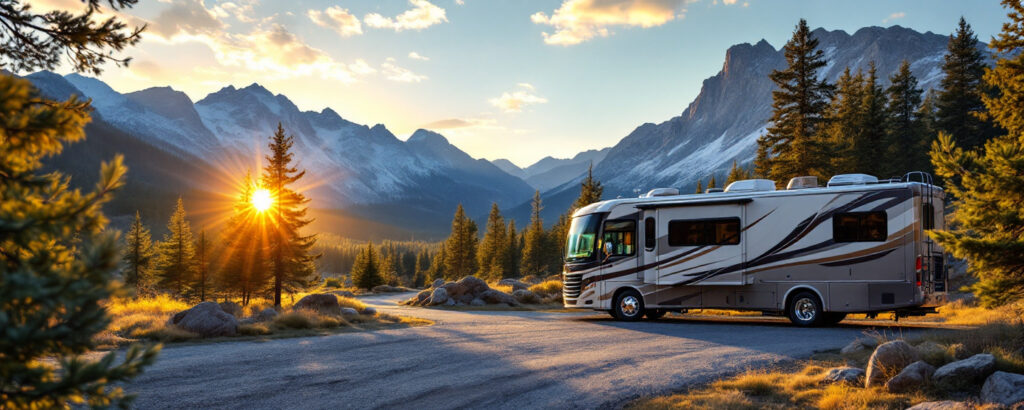
A big rig is a large recreational vehicle — generally a Class A motorhome or fifth-wheel trailer 40 feet or longer, frequently 43–45 feet, and often towing a second vehicle. It's not a truck-driving term here; it's the class of RV big enough that "will I fit?" becomes a real question at every stop. The defining problem isn't just length — it's length, weight, turning radius, slide-out width, and ride height all at once.
Why it matters for a big rig: This is the whole reason this directory exists. Anything under about 35 feet usually slots into a standard campground without a second thought. Big rigs don't.
Class A Motorhome
A Class A motorhome is the bus-shaped, drive-it-yourself RV built on a heavy commercial or bus chassis. It's the largest motorized class, typically running 30 to 45 feet, with a flat front and a big windshield. The living space sits over the cab, so you get the full length as usable interior. Many big rigs are 40-foot-plus Class A coaches.
Why it matters for a big rig: A 45-foot Class A is right at the top end of what most parks can take. Confirm the max rig length and ask for a pull-through any time you're at 45 feet or running slides on both sides.
Class C Motorhome
A Class C motorhome is built on a cutaway van or truck chassis and is easy to spot by the cab-over bunk — that sleeping pod that hangs over the truck cab up front. They're generally smaller than Class A coaches, commonly 22 to 35 feet, and a typical one stands somewhere around 10 to 11 feet tall.
Why it matters for a big rig: Most Class C rigs aren't "big rigs" by our 40-foot bar, but a long Super C can be. If you're shopping the line between classes, the length and clearance numbers are what put you into big-rig territory.
Super C
A Super C is a Class C body built on a heavy-duty medium-truck chassis — the same cab-over shape, but on a diesel commercial frame meant to haul serious weight. They run large and heavy, often 35 to 45 feet, and tow like a freight truck.
Why it matters for a big rig: A Super C is every bit a big rig even though it wears a Class C silhouette. Score it on length, weight, and turning radius — not on the badge.
Fifth Wheel
A fifth wheel is a towable RV that hitches to a special plate mounted in the bed of a pickup truck, rather than to a bumper or rear hitch. The front section rides up over the truck bed, which is where the gooseneck-style coupling and the name come from. Big-rig fifth wheels often run 35 to 43 feet of trailer, and that's before you add the truck.
Why it matters for a big rig: Remember to count the truck. A 40-foot fifth wheel plus a long-bed dually is well past 55 feet of combined length, and that total is what has to fit the site and swing the turns.
Travel Trailer
A travel trailer is a towable RV that hitches to a ball mount at the rear of the tow vehicle, sitting fully behind it rather than over the bed. They range widely in size, from small teardrops up past 40 feet on the largest units.
Why it matters for a big rig: A long travel trailer can hit big-rig length, but it tends to sway and maneuver differently than a fifth wheel because of where it hitches. Long ones need the same length and turn-radius scrutiny as any big rig.
Toy Hauler
A toy hauler is a fifth wheel or travel trailer with a built-in garage at the back and a fold-down ramp door, made to carry motorcycles, a side-by-side, or other gear. That garage adds length and weight on top of the living space.
Why it matters for a big rig: Toy haulers are often among the longest and heaviest trailers on a site. The garage section pushes total length out, so the max rig length number matters even more than usual.
Diesel Pusher
A diesel pusher is a Class A motorhome with its diesel engine mounted in the rear — it pushes the coach instead of pulling it. The layout makes for a quieter cab and strong torque for climbing, and pushers tend to be the biggest, heaviest motorhomes on the road, commonly 38 to 45 feet.
Why it matters for a big rig: Pushers run on diesel, so fuel access on our scoring is about diesel pumps a big coach can actually pull into — not every gas station qualifies. They also weigh enough that grade and brakes get real attention.
Toad / Dinghy
A toad (also called a dinghy) is the small vehicle you tow behind a motorhome so you've got something to drive once you've parked the rig. It's usually flat-towed on all four wheels and adds roughly 15 to 20 feet to your total length.
Why it matters for a big rig: Your real length is the rig plus the toad. A 45-foot coach towing a Jeep is pushing 60-plus feet, and that's the number that has to clear the entrance, the turns, and the site — not the coach length on the brochure.
The seven criteria (what we actually score)
Pull-Through Site
A pull-through site is a campsite you drive into at one end and out the other, with no backing required. You arrive, pull forward, level, and you're set — and you leave the same way.
Why it matters for a big rig: This is the single biggest convenience factor in our maneuverability score. For a 40-foot-plus rig, especially after a long day, a pull-through is the difference between a two-minute setup and a 12-point backing job with an audience.
Back-In Site
A back-in site is a campsite you have to reverse into, the way you'd parallel park — except you're reversing 40 feet or more of rig into a defined space, often with neighbors and trees on both sides.
Why it matters for a big rig: Back-ins aren't a dealbreaker, but they lower the maneuverability score and reward planning. Call ahead, request a roomy site, and have a spotter. The longer the rig, the more a tight back-in stings.
Full Hookup
A full hookup site gives you all three utility connections at the pad: electric, fresh water, and sewer. "Partial hookup" usually means electric and water but no sewer, which forces you to use a dump station instead.
Why it matters for a big rig: Big rigs carry big tanks and use real power. Full hookups — paired with the right amperage — mean you can settle in for a stretch without breaking camp just to dump tanks.
50-Amp Service
50-amp service is the higher-capacity electrical hookup, delivering far more usable power than a standard 30-amp connection. It's the standard a big rig wants because larger coaches run two air conditioners, residential fridges, and more on top of everything else.
Why it matters for a big rig: On a hot afternoon with two ACs running, 30-amp service will have you choosing which appliances to turn off. 50-amp is what lets a big rig run like it's built to. It's part of our site-type-and-power score for a reason.
Low Clearance
Low clearance means a height restriction ahead — a bridge, overpass, tunnel, gateway arch, covered fuel canopy, or tree canopy lower than your roofline. A low-clearance sign posts the maximum safe height; if your rig is taller, you don't fit.
Why it matters for a big rig: Most big rigs stand near the legal RV ceiling of about 13 feet 6 inches, so clearances that a car or van shrugs off can stop you cold. We flag clearance conservatively — when in doubt, we warn rather than reassure, because a roof strike is the one mistake you can't undo.
Approach Grade
Approach grade is how steep the road is getting into (or out of) a stop — the climbs and descents on the access road, not the campsite itself. A steep grade strains brakes on the way down and the drivetrain on the way up, and it gets serious fast for a heavy rig.
Why it matters for a big rig: A loaded diesel pusher or a Super C carries a lot of momentum. In flat states grade rarely matters; in mountain country it can be the limiting factor even when everything else scores well. That's why we warn on grade separately.
Runaway Truck Ramp
A runaway truck ramp is an emergency escape lane — usually a long bed of deep, loose gravel climbing uphill off the side of a steep mountain descent — built to safely stop a heavy vehicle whose brakes have overheated and faded. You'll see them flagged in advance with signs on long downgrades.
Why it matters for a big rig: If you ever see one and think you might need it, you've already let your brakes get too hot — so a runaway ramp is really a signal to read the mountain. On a steep descent, gear down, keep your speed off the brakes, and let the engine and transmission do the holding. The ramp is the last resort, not the plan.
Boondocking
Boondocking is camping with no hookups at all — no shore power, water, or sewer connection — relying entirely on your batteries, fresh tank, and holding tanks. It's common on public land and in the wide-open dispersed sites out West.
Why it matters for a big rig: Boondocking is great until the spot you drove three miles of dirt road to reach turns out to be too tight to turn a 45-foot coach around in. For big rigs, the real question is rarely the lack of hookups — it's access and room to maneuver. Scout it before you commit the whole rig.
Dry Camping
Dry camping means camping without hookups — same idea as boondocking, but the term is most often used for no-hookup stays inside an established spot: a parking lot, a fairground, a rally field, or a basic campground site with no utilities. The "dry" part is the missing water, sewer, and power.
Why it matters for a big rig: Plenty of big-rig overnights are dry — a lot at a casino, a rally, a stop between destinations. What matters there is whether you can get the rig in, get reasonably level, and get back out, which is exactly what our overnight and maneuverability scoring looks at.
Common questions
What's another word for "big rig"?
In the RV world, a big rig is also called a Class A motorhome, a diesel pusher (for diesel models), or simply a "40-footer" — and fifth-wheel trailers 40 ft and longer count too. ("Big rig" also means a semi-truck in trucking; on this site it always means the large-RV sense.) See the full definition.
How these terms connect
Every term on this page feeds the same scoring system. The rig types tell you what you're driving; the seven criteria are the data points we measure at every stop and roll into a single 1–10 number. If you want the full rubric — how length, maneuverability, clearance, grade, fuel, and overnight rules combine into one comparable score — start at the canonical definition: Big-Rig Friendly, Defined.
Related: Big-Rig Friendly Campgrounds by State · Big-Rig Friendly Restaurants by State · Big-Rig Friendly Stops Along the Interstates